
Blog entry by Sam Sam
Published Date: 30 January 2026
One of the most overlooked skills in Da'wah is the ability to make truth felt before it is fully understood. Many people assume that guidance arrives through argument, evidence, or intellectual pressure. Yet when we look closely at the Qur’an, we see something far more subtle and far more powerful at work.
Allah does not merely state truths. He paints them.
He allows people to recognise reality through images they already understand, moments they have already lived, and experiences their hearts already carry. This is the power of analogy, and it is not a secondary tool in Da'wah. It is a divine method.
Allah Himself says, “And these examples We present to the people, but none will understand them except those of knowledge.” Surah Al-‘Ankabut 29:43.
Analogies are not used because people are incapable of understanding truth. They are used because the human heart often opens before the intellect submits.
Why analogies reach where arguments cannot
Arguments often activate defensiveness. Analogies disarm it.
When a person feels debated or attacked, they prepare to resist. When a person hears an analogy, they are invited to reflect. This is why analogies bypass ego and go straight to recognition. They do not accuse. They reveal.
The Qur’an uses analogies to turn abstract concepts into lived reality. Truth and falsehood are no longer philosophical ideas. They become water and foam. Reliance is no longer a concept. It becomes a spider’s web. Guidance is no longer a theory. It becomes light after darkness.
People may forget what you argued, but they rarely forget what they saw or how they felt.
How the Qur’an presents truth and falsehood
One of the most striking Qur’anic analogies appears in Surah Ar-Ra‘d. Allah describes rainwater flowing through valleys, carrying foam on its surface. The foam rises visibly and seems dominant, while the water that actually benefits people continues beneath it. Allah then says, “As for the foam, it vanishes, being cast off; but as for that which benefits the people, it remains on the earth. Thus does Allah present examples.” Surah Ar-Ra‘d 13:17.
This analogy quietly dismantles a major psychological obstacle in Da'wah. Falsehood often appears louder, more popular, and more confident. Truth can seem slower, quieter, and marginal. Yet Allah reframes success not by visibility, but by benefit and endurance.
No confrontation is needed. The listener already knows this pattern from life.
Illustrating misplaced reliance through everyday imagery
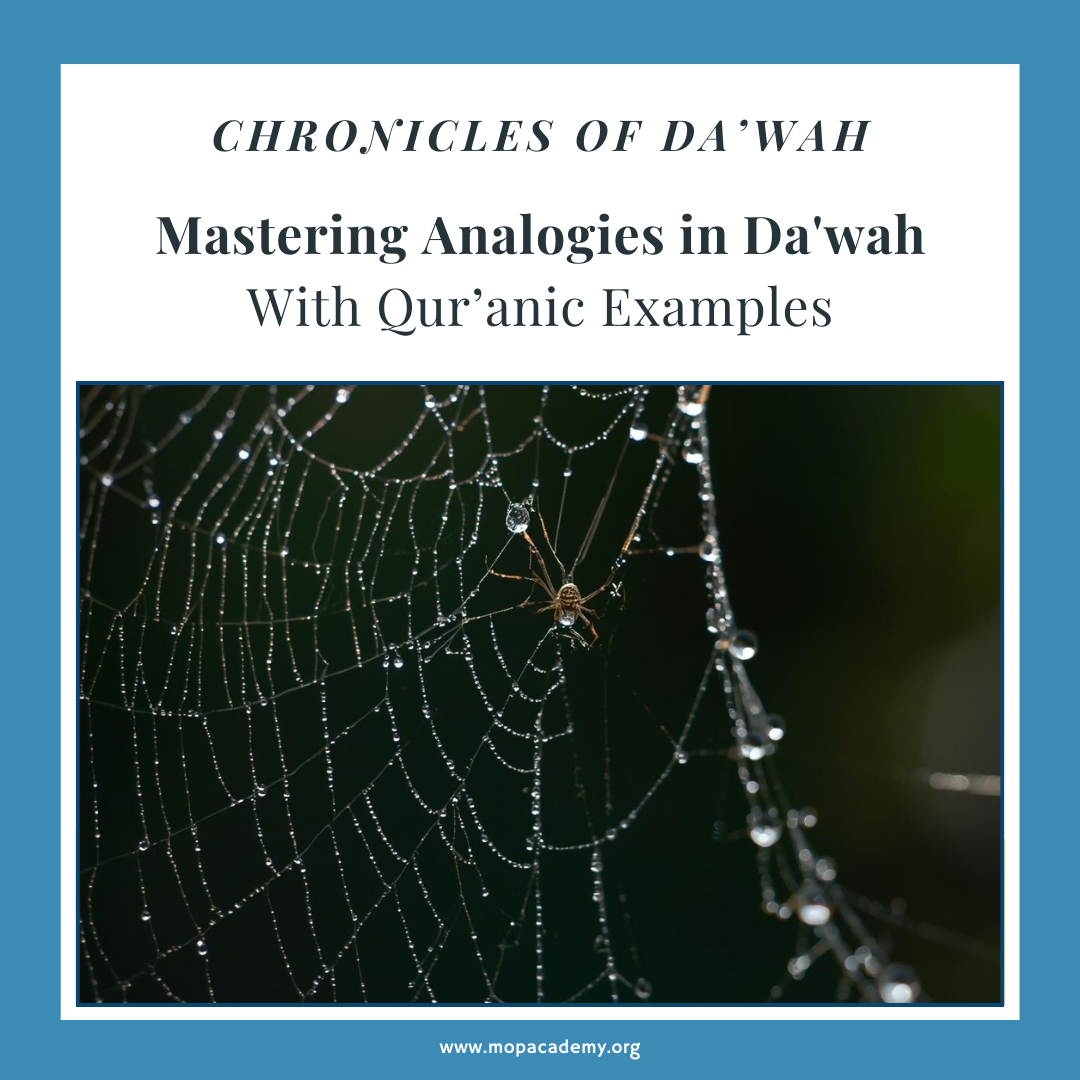
Another powerful example appears in Surah Al-‘Ankabut, where Allah addresses reliance on other than Him. “The example of those who take allies other than Allah is like that of the spider who takes a home. And indeed, the weakest of homes is the home of the spider, if they only knew.” Surah Al-‘Ankabut 29:41.
A spider’s web looks complex and impressive, yet it offers no protection from the slightest disturbance. This analogy resonates deeply with people who appear stable on the surface but feel anxious underneath. Without attacking beliefs, careers, or lifestyles, the Qur’an exposes the fragility of placing ultimate trust in anything created.
It is an invitation to reflect, not a demand to submit.
Making sense of the temporary nature of the world
Many people struggle not because they love the world too much, but because they expected it to give what it never promised. The Qur’an addresses this gently, using imagery that feels universally familiar.
In Surah Al-Hadid, Allah compares worldly life to rain that produces growth which delights farmers, then dries, turns yellow, and becomes scattered debris. “Know that the life of this world is but amusement and diversion and adornment and boasting to one another and competition in increase of wealth and children…” Surah Al-Hadid 57:20.
This analogy does not condemn enjoyment or success. It simply restores perspective. The problem is not the rain. The problem is forgetting that seasons change.
For many people today, this analogy explains feelings of burnout and emptiness better than any argument could.
Guidance described as life and light
Perhaps one of the most emotionally powerful Qur’anic analogies is how Allah describes guidance itself. “Is one who was dead and We gave him life and made for him light by which to walk among the people like one who is in darkness, never to emerge from it?” Surah Al-An‘am 6:122.
Here, faith is not presented as information, identity, or culture. It is presented as resurrection. Misguidance is not framed as stupidity, but as disorientation.
This matters deeply in Da'wah. People are not rejecting Islam because they love darkness. Many are simply lost within it.
The Prophet ﷺ and analogies in Da'wah
The Messenger of Allah ﷺ followed this same Qur’anic method consistently. He spoke to people using images drawn from their daily lives, allowing truth to settle naturally.
In an authentic hadith recorded in Sahih al-Bukhari, he ﷺ compared the guidance Allah sent him with to rain falling on different types of land. Some land absorbed it and produced growth. Some held water and benefited others. Some neither held water nor produced anything.
The Messenger of Allah ﷺ said:
“The example of what Allah has sent me with of guidance and knowledge is like abundant rain falling upon the earth. Some of the land was fertile and absorbed the rainwater and brought forth vegetation and grass in abundance. Another portion of the land was hard and held the rainwater, so Allah benefited the people with it, and they drank from it, irrigated with it, and cultivated the land. And another portion of the land was barren; it neither held the water nor brought forth vegetation. Such is the example of the one who understands the religion of Allah and benefits from what Allah has sent me with, so he learns and teaches others; and the example of one who does not raise his head to it and does not accept the guidance Allah sent me with.”
The lesson is both profound and merciful. Hearts differ. Responses vary. Guidance belongs to Allah. The caller’s responsibility is delivery, not results.
This analogy protects the da‘iyah from arrogance when people respond positively, and from despair when they do not.
Using analogies wisely in modern Da'wah
Analogies are powerful, but they must be used with care. The Qur’an never allows analogy to distort belief or replace revelation. Analogies clarify truth, they do not redefine it.
The most effective analogies are usually simple, relatable, and directly connected to the listener’s experience. Overcomplicating them weakens their impact. Explaining them excessively often robs them of their effect.
A well-placed analogy followed by silence can be more powerful than ten more minutes of speech.
Practical guidance for mastering analogies in Da'wah
To use analogies effectively, callers must first become attentive students of the Qur’an, noticing how Allah introduces examples, what emotions they evoke, and how they guide the listener toward reflection rather than force.
Everyday life is full of material for Da'wah. Light and darkness, journeys and destinations, sickness and healing, growth and decay. These are universal experiences that transcend culture and language.
Analogies should always point back to Allah, never to the cleverness of the speaker. They are bridges to truth, not performances. When used sincerely, they allow people to recognise what their hearts already know.
Practical Analogies We Can Use in Real Da‘wah
-
“Guidance is like a map on a journey”
You might say:
“Imagine you’re driving through an unfamiliar country at night. You can keep driving confidently, but confidence doesn’t mean you’re going the right way. A map doesn’t restrict you. It prevents you from getting lost. This life is a journey and the Qur’an is our map for navigating through it.”
Why this works:
Many people think guidance limits freedom. This analogy reframes guidance as clarity, not control. It’s especially effective with people who value independence and exploration.
Worship is like charging your phone
You might say:
“Your phone doesn’t mean anything is wrong when the battery runs low. It just means it needs charging. Acts of worship are how the soul recharges.”
Why this works: It normalises spiritual lows without guilt. People today understand battery life more than theology.
Best used when discussing:
• Salah
• Burnout
• Feeling distant from God
• Why regular worship matters
Sin is like poison taken in small doses
You might say:
“No one drinks poison expecting to collapse immediately. Small amounts seem harmless at first. The damage happens quietly, over time.”
Why this works: It avoids shame and focuses on consequence rather than moral superiority.
Best used when discussing:
• Habitual sins
• ‘It’s not that bad’ thinking
The dunya is like a hotel, not a home
You might say:
“When you stay in a hotel, you enjoy it, but you don’t redecorate or panic when checkout comes. The problem is when we forget this world was never meant to be permanent.”
Why this works: It explains detachment without promoting neglect.
Best used when discussing:
• Materialism
• Loss
• Death
• Over-attachment to success
Faith grows like a muscle, not a switch
You might say:
“No one walks into a gym strong with full muscles. Strength comes with repetition. Faith works the same way. Consistency matters more than intensity.”
Why this works: It removes perfectionism and despair.
Best used when discussing:
• New Muslims
• Weak iman
• Consistency in worship
A final reflection for callers to Islam
Allah did not choose analogies randomly. He chose them because the human heart recognises truth when it sees itself reflected.
When you use analogies in Da'wah, you are not simplifying Islam. You are following revelation.
“And Allah presents examples for the people, and Allah is Knowing of all things.” Surah An-Nur 24:35.
Speak with clarity. Invite reflection. Trust Allah with the outcome.
Guidance does not need to be forced. It needs to be recognised.